As a response to the Pope’s call to dialogue, the UNESCO Chair in Bioethics and Human Rights, established at Faculty of Bioethics of the Pontifical Athenaeum Regina Apostolorum and Faculty of Law of Università Europea di Roma, organised a two-day workshop to study the document in light of other different traditions, including Islam, Judaism, Greek Orthodoxy, Buddhism, Confucianism, and Hinduism.
2021
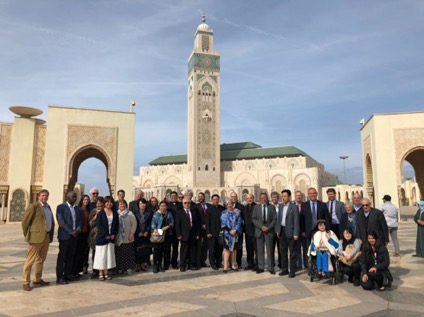
7th International Bioethics, Multiculturalism and Religion Workshop on Protecting the Future Generation and the Ethics of Human Reproduction was held in Casa blanca,Morocco. It was organised by the UNESCO Chair in Bioethics and Human Rights, in partnership with Foundation Cultures du Monde and the Fondation de la Mosquée Hassan II.
The goal of the conference is to create a forum for sharing and exchanging views on current and widely debated issues.The conference was centred on Article 16 of the UNESCO Declaration on Bioethics and Human Rights, “The impact of life sciences on future generations, including on their genetic constitution should be given due regard.” Under this framework, it focused on the ethics of human reproduction, more specifically on pre-natal Testing, pre-implantation genetic diagnosis, and maternal surrogacy.
The conference was divided into ten sessions. Experts from different religions (Buddhists, Christians, Confucians, Hindus, Islam and Jews) and secular traditions will address the scope and application of Article 16 of the UNESCO Universal Declaration of Bioethics and Human Rights. The three-day event also included the 19th annual "Come to my Home" on the theme "Protecting Future Generations." The public will be welcomed to an inter-religious bioethics workshop, "What is bioethics and what is the contribution of religions?" followed by a musical concert by the group "CTMH" organised by the Foundation des Cultures du Monde, founded by former minister Driss Alaoui Mdaghiri.As Prof. Alberto Garcia, Director of the UNESO Chair in Bioethics and Human Rights states, "proper attention must be given to the impact of life sciences on future generations including their genetic constitution, with the aim of promoting dialogue and encouraging mutual understanding among people from different cultures and traditions."The conference was of great artistic, scientific and cultural richness with the intent to encourage mutual understanding and promote the universal values that belong to human heritage.
“Multicultural and Inter-religious Perspectives on the Ethics of Human Reproduction”Editors: Joseph Tham, Alberto Garcia Gómez, John LunstrothPublisher: SpringerYear: 2021Link: springer.com
This book includes a number of distinct religious and secular views on the anthropological, ethical and social challenges of reproductive technologies in the light of human rights and in the context of global bioethics. It includes contributions of bioethics experts from six major religions—Buddhism, Confucianism, Christianity, Islam, Hinduism, and Judaism—as well as secular authors. The chapters include commentaries discussing the content cross-religious/secular tradition to give a comparative perspective.
Not only the volume editors but also the contributing authors took part in reviewing each other’s chapter making this a unique collected volume, not common in inter-religious dialogue today. This text appeals to researchers and students working in the fields of bioethics and religious/secular studies.


.png)